Buying Guide · Updated 23 November 2026

Flower Vending Machine Buying Guide: How to Choose, Cost and Launch One

Everything we tell buyers on the phone, written down: what these machines really cost, which model fits which location, how the numbers work, and the questions that separate a factory from a reseller.

See the cost breakdown
  • 4 models · 8–11 slots, more on request
  • 2–25°C refrigeration
  • CE / FCC / SGS · ISO 9001
  • Factory direct since 2016
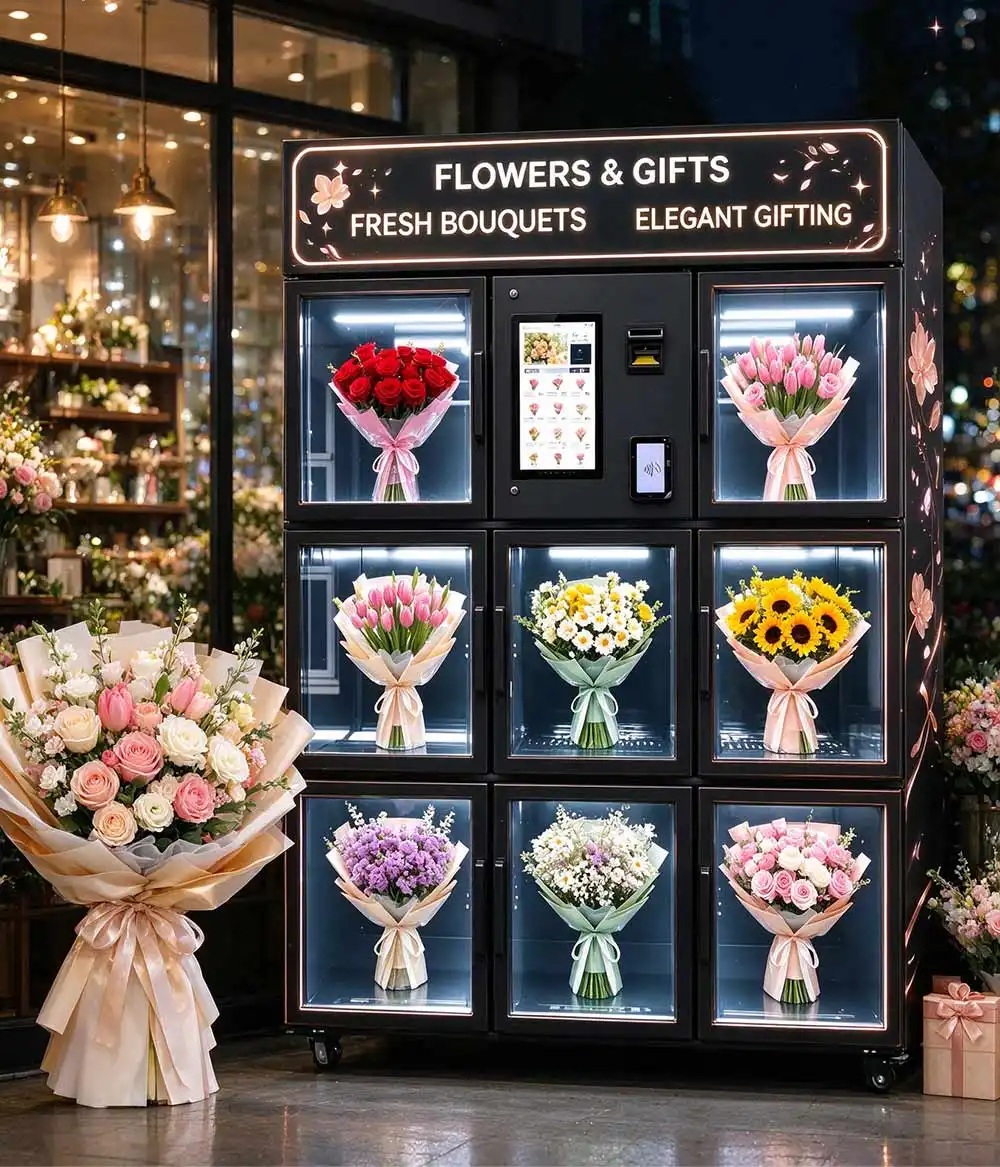
Refrigerated flower vending machine full of bouquets, lit shopfront at night

The short answer

A flower vending machine is a refrigerated self-service cabinet that sells fresh bouquets around the clock. Factory-direct prices run from US$3,500 to US$4,600 for 8–11 slot models; a realistic all-in budget for a first site is US$4,500–5,500 once freight, duty, unloading and first stock are counted. With a $10–17 gross margin per bouquet and 10–30 sales a day, most operators look at a one to three month payback — but location and restocking discipline decide that, not the machine.

  • Best first machine: 8–11 slots, 2–25°C, anti-fog glass, card + QR payments.
  • Budget to plan for: machine price + 15–25% for freight, duty, delivery and stock.
  • Time to launch: 20–30 days production, 15–40 days sea freight, one day to install.
  • What to check first: slot height for your bouquets, then the site contract.

Below is the long version — costs, a 10-point checklist, every model we build, and the questions to ask any supplier. This flower vending machine buying guide is updated whenever prices or models change, so bookmark it rather than trusting a three-year-old blog post. Skip straight to the checklist →

In This Guide

What this flower vending machine buying guide covers

Fourteen sections, in the order a buyer actually needs them — from “what is it” to “who do I pay”.

  1. 01What a flower vending machine is (and how it works)
  2. 02What a machine costs — and what the first month really costs
  3. 03The unit economics: bouquets, margin, ROI and payback
  4. 04The 10-point buying checklist we use ourselves
  5. 05The four models we build — 8 and 11 slots
  6. 06Best locations for a flower vending machine
  7. 07Freshness, restocking and maintenance
  8. 08Permits, insurance and site agreements
  9. 09How to vet a manufacturer before you pay
  10. 10Five-year cost of ownership
  11. 11Machine vs flower shop vs mobile cart
  12. 12A 30-day launch plan
  13. 13Eight expensive mistakes
  14. 14Frequently asked questions
Section 01

What a flower vending machine is (and how it works)

A refrigerated flower vending machine is a large illuminated cabinet divided into individually locked compartments — a fresh flower vending machine and a 24-hour flower shop in one unit. Each compartment is a sealed mini display case held at 2–25°C, so a wrapped bouquet stays sale-ready from the moment it is loaded until a customer buys it, with no staff, no storefront and no closing time.

How a purchase works, in four steps

  1. 1
    Stock and chill. Wrapped, pre-hydrated bouquets go into the slots; the cabinet holds its set temperature.
  2. 2
    Customer chooses. The buyer sees the real bouquet through clear glass and selects it on the touchscreen — what they see is what they get.
  3. 3
    Pay and dispense. Cash, bank card or QR / mobile wallet; only the purchased compartment unlocks, in seconds, day or night.
  4. 4
    Restock. A 30–60 minute visit refills the slots; per-slot sales and stock levels are already on your phone.

Not a flower fridge, not a display cooler: the machine sells. Payment release, lock control, stock data and temperature alerts are one system, which is why a converted drinks cabinet never performs the same way.

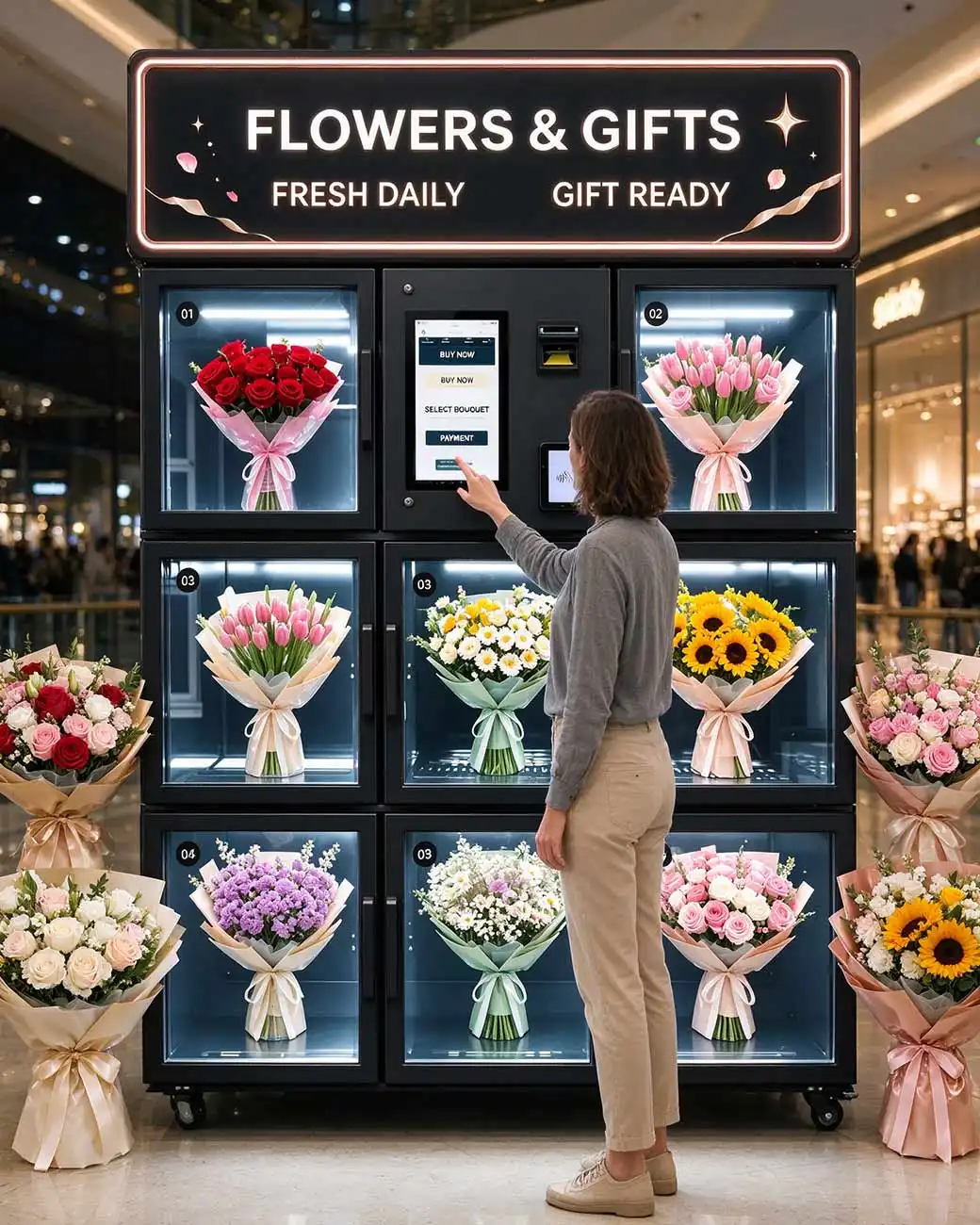
Customer paying at the touchscreen of a refrigerated flower vending machine in a mall
Buying takes about 30 seconds: see the bouquet, tap, pay, collect.

What is inside the cabinet

ComponentWhy it matters to a buyer
Refrigerated cabinetOne-piece moulded polyurethane foam holds a stable 2–25°C — the band florists use for cold storage.
Anti-fog showcase glassElectric dehumidification keeps the glass clear, so bouquets look their best behind it.
Sealed slots with individual locksOnly the paid compartment opens. Dust, draughts and knocks stay out; theft stays difficult.
Air-cooling circulationCold air moves across every shelf instead of pooling at the bottom, so no slot runs warm.
Touchscreen + payment stack10.1\u2033, 15.6\u2033 or 21.5\u2033 screen with cash, bank card and QR / mobile wallet modules fitted for your market.
Remote management moduleStock per slot, sales history and live cabinet temperature on your phone.
Section 02

How much does a flower vending machine cost?

The machine is the number everyone asks about, and the one that matters least in the first month. Here is the full budget, with the part that suppliers usually leave out of the quotation.

Cost lineTypical amountWhat it covers
Machine, 8-slot, factory direct US$3,500 – 4,600 Published base prices: Grid 8 and Bloom Box 8 at $3,500, Garden 8 at $3,600, Arc 11 at $4,600. Other slot counts (5, 10, 13, 24) are built to order — contact us for a quote.
Refrigeration, lighting, locks, screen Included Standard on every model — there is no cheaper “dry” version to be upsold into.
Payment module for your market Included in quote Cash, card and QR modules are configured before shipping; special integrations are priced per project.
Sea freight, one machine US$350 – 1,200 (estimate) Depends on destination port and Incoterm. Air freight is faster and dearer; spare parts always ship by air.
Import duty and local taxes 0 – 15% of value (estimate) Set by your country and the HS code used at clearance. Ask for the code before you compare quotes.
Delivery, unloading, commissioning US$0 – 500 (estimate) Two people and a pallet truck. No building work, no plumbing; we commission remotely by video.
First stock (60–100 bouquets) US$400 – 800 Based on a $4–8 landed cost per wrapped bouquet. Start narrower than you think you need.
Site rent or revenue share Location-specific Malls and airports often take a commission on sales instead of fixed rent — model it before signing.
Spare-parts kit Included Locks, fuses, sensors and conveyor parts ship with the machine, plus a lifetime parts supply commitment.
Working capital and contingency ≈10% of the total Covers the first six weeks of stock before sales settle into a rhythm.

Read the labels. Machine prices are published factory-direct prices. Freight, duty and delivery figures are estimates to help you budget — the only number you can hold us to is the one on your quotation, which is issued with your destination port and Incoterm.

What a real first-month budget looks like

An 8-slot machine at US$3,500 + about US$800 for sea freight and duty + US$400 for delivery and first stock + a US$500 contingency lands near US$5,200. On top of that, budget the site rent or revenue share for the first month and roughly 78 hours a year of restocking time — the machine is the cheap part, the flowers and the location are the business.

What drives the price up or down

Slot count and cabinet width

More slots mean more steel, more locks and more refrigeration load. A 13 or 24-slot cabinet costs meaningfully more than an 8-slot Grid — and needs more stock to fill it.

Payment configuration

Cash, card and QR modules are fitted before shipping. Special local integrations or multi-currency setups are quoted per project, so state your market early.

Freight, duty and Incoterm

Two quotes for the same machine can differ by 30% because one is EXW and the other is DDP. Compare landed cost, not headline price.

Buy outright, lease or finance a flower vending machine?

Every machine is sold factory-direct, but how you pay changes the monthly numbers. Ask for the flower vending machine price list before you compare finance offers — an interest rate is only meaningful against the real purchase price. If you are weighing a flower vending machine lease against outright purchase, compare the total paid over the full term, not the monthly figure.

Outright purchase Lowest total cost and full ownership of the asset. The right choice when you have the capital and intend to keep the machine for years.
Lease or revenue share Lower entry cost, and sometimes bundled with a location. Read the total paid over the term and who owns the machine at the end.
Equipment finance Spreads the cost monthly while you keep ownership. Compare the APR against expected monthly gross profit, not against the sticker price.
Section 03

Flower vending machine ROI: bouquet margin and payback

Flower vending works because the margin per bouquet is high and the basket is emotional. These are sample figures from our operator conversations — use them as a model, not a promise.

ItemSample valueNotes
Bouquet retail price $15 – 25 Wrapped bouquet, mid-market city pricing.
Cost per bouquet (flowers + wrap) $4 – 8 Depends on stem count, species and season.
Gross profit per bouquet $10 – 17 Before rent, power, payment fees and your time.
Daily sales, mid-footfall site 10 – 30 bouquets Gift-driven locations; weekends and holidays run higher.
Sample daily gross profit $100 – 450 Illustration, not a forecast.
Sample monthly gross profit $3,000 – 13,500 Illustration, not a forecast.

Break-even per machine

Machine + freight + first stock≈ US$5,200

Gross profit per bouquetUS$10 – 17

Bouquets to break even≈ 300 – 520

At 15 sales a day20 – 35 days

How to sanity-check the numbers yourself

  • Count real foot traffic past the spot for 30 minutes at three different times of day, then multiply.
  • Assume a conservative 1–3% of that traffic buys flowers — not everyone carries a gift.
  • Subtract site rent or commission, power (about 1 kW), payment fees (typically 1.5–3.5%) and your restocking time.
  • Test with a standard 8-slot machine before you commit to a larger custom cabinet for the same site.

Payback in one to three months is realistic on the sample above; if your site scores below 12 on the six-criteria test in the location section, fix the site before you buy more slots.

Section 04

The 10-point flower vending machine buying checklist

There is no single best flower vending machine — there is the best one for your site, your bouquets and your budget. Print this and take it to the supplier meeting: each point has the standard to look for and the question to ask, and if a supplier dodges two of them, walk away.

01

Temperature range and insulation

A real 2–25°C range with a one-piece foam cabinet and a compressor that holds temperature when the door area is busy. Cheap units drift to 10–15°C and halve vase life.

Ask: What is the measured cabinet temperature after 24 hours with a full load?

02

Anti-fog glass

Heated or dehumidified glass. Without it, the display fogs every morning and customers cannot see what they are buying.

Ask: Is the anti-fog system electric, and is it covered by warranty?

03

Slot height for your bouquets

Measure your tallest wrapped bouquet first, then check slot height and depth — not just the slot count. A large cabinet with short compartments sells single stems, not gift bouquets.

Ask: What is the usable height and depth of one slot?

04

Individual compartment locks

One lock per slot, released only after payment. This is both a theft control and a freshness control — nothing is opened “to browse”.

Ask: Show me the lock release mechanism on video.

05

Payments your customers actually use

Card, NFC and QR configured for your country, with settlement to your account. Cash-only machines lose sales in card-first markets.

Ask: Which payment providers are supported for my country, and what are the fees?

06

Remote stock and temperature monitoring

Per-slot inventory, sales history and temperature alerts on a phone. This is what makes a five-machine route manageable by one person.

Ask: Can I see a live demo of the dashboard before ordering?

07

Sales and product mix data

You need to know which slot sells and at what hour, otherwise you restock by guesswork and carry dead stock.

Ask: Does the report break down sales per slot and per hour?

08

Footprint, weight and power

Confirm the machine fits the doorway, lift and floor loading, plus the voltage and circuit available on site. A 3-metre-wide model solves traffic but not a narrow corridor.

Ask: What is the exact crate size and weight for shipping?

09

Certifications and test reports

CE, FCC, RoHS and SGS certificates plus an ISO 9001 factory. These are also what customs and your landlord will ask for.

Ask: Can you send certificate copies with the quotation?

10

Warranty, spare parts and training

12 months on the machine, a fast parts channel, a written parts price list and staff training. Ask who pays the courier when a part fails.

Ask: What is the parts dispatch time, and who pays freight during warranty?

Want us to run this checklist against your site and your budget? .

Section 05

Flower vending machine models: 8 and 11 bouquet slots

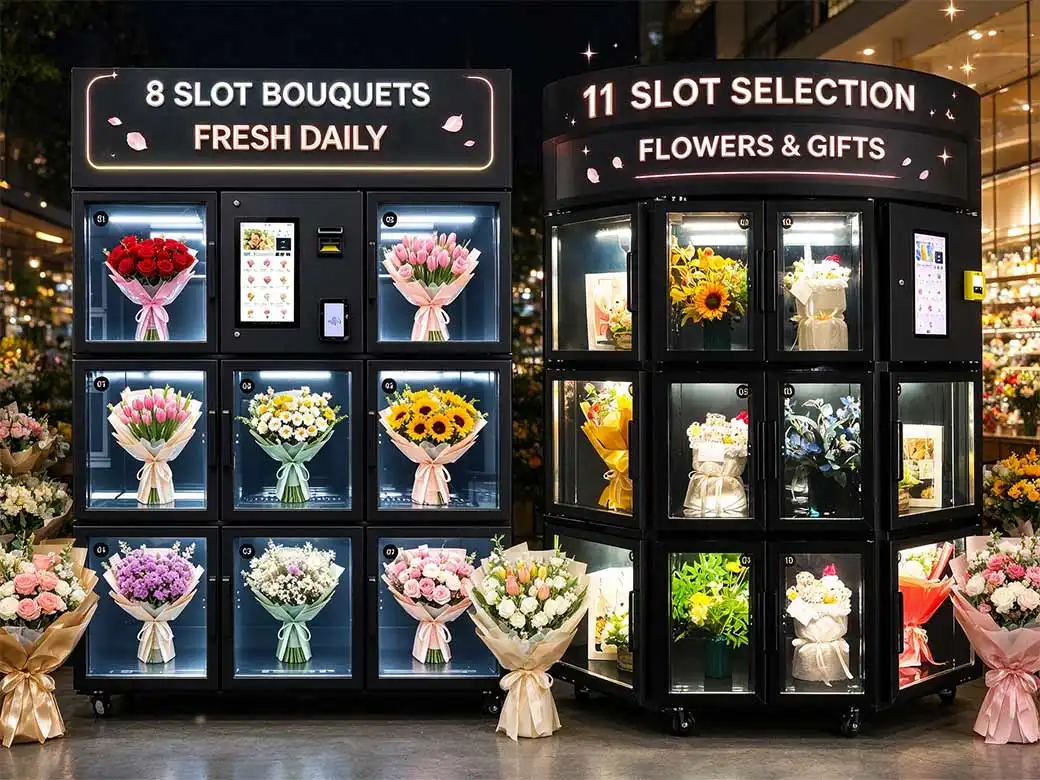
Four standard flower vending machine models share one platform: 2–25°C refrigeration, sealed illuminated compartments, touchscreen ordering and CE / FCC / RoHS / SGS / ISO 9001 certification. The differences are slot count (8 or 11), screen size, cabinet footprint and how big a bouquet each slot accepts. Every flower vending machine for sale here is built in our own factory — ask for the current flower vending machine price list and we will send it with freight to your port. Flower vending machine dimensions matter more than photos suggest: check them against your doorway, lift and floor before you choose, because the widest standard model is 1,715 mm across.

Model Code Slots Screen H × W × D (mm) Price (USD) Best for
Grid Series 8Best for: Convenience stores, compact retail WMT-F01 8 15.6" 2122 × 1500 × 797 US$3,500 Convenience stores, compact retail
Bloom Box SeriesBest for: Gift shops, hotel lobbies WMT-F02 8 21.5" 2122 × 1500 × 797 US$3,500 Gift shops, hotel lobbies
Garden Series 8Best for: Deep bouquets, retail floors WMT-F03 8 21.5" 1992 × 1350 × 920 US$3,600 Deep bouquets, retail floors
Arc Series 11Best for: Atriums, statement placement WMT-F04 11 15.6" 2067 × 1715 × 985 US$4,600 Atriums, statement placement

All four models: 2–25°C, 950 W, 110V or 220–240V AC 50/60Hz configurable. Prices are factory-direct reference prices for the base machine; payment modules, shipping and customisation are quoted per order.

Need a different slot count?

Our standard range is 8 and 11 slots, but we also build 5, 10, 13 and 24-slot cabinets to order. Tell us the slot count, the height of your tallest bouquet and where the machine will stand — you will have a specification and a factory quote within 24 hours.

How many slots do you actually need?

Use your sell-through, not your ambition. The formula that keeps stock fresh:

Slots ≈ daily bouquet sales × days between restocks

At 12 sales a day with two restocks a week, you need roughly 42 sales of capacity — more than any standard cabinet holds, which is why most operators run 8–11 slots and restock every three to four days instead of chasing capacity. If your site genuinely sells that volume, we build 13 and 24-slot cabinets to order — ask us before you assume you need one.

Four starting points

  • First machine, mixed site: Grid Series 8 or Bloom Box 8 — 8 slots, 15.6" or 21.5" screen, US$3,500.
  • Gift shop or hotel lobby: Garden Series 8 — deeper compartments for full bouquets, US$3,600.
  • Statement placement: Arc Series 11 — the largest standard cabinet, more display choice in a high-traffic atrium, US$4,600.
  • Other capacities: 5, 10, 13 and 24 slots are built to order — contact us with the slot count you need.
Two refrigerated flower vending machines side by side showing 8-slot and 11-slot cabinets
Slot count is a stock decision, not a status symbol.
Section 06

Best flower vending machine locations (and how to score one)

The machine does not create demand; it catches demand that already exists. Look for dwell time plus a gifting trigger — a reason to buy flowers within the next ten minutes. People search for this in different words: a bouquet vending machine, a rose vending machine, a 24-hour flower kiosk. The requirement is identical — a place where someone already needs flowers today.

Hospitals

Visitors need flowers outside florist hours, often urgently. The gift is emotional and price-sensitive in the right direction.

Steady weekday traffic, peaks in visiting hours.

Shopping malls

Place near fashion, jewellery or the food court — people already in a spending mood, already carrying gifts.

Weekend-heavy; strong around holidays.

Metro and train stations

Commuters buy on the way home with an occasion at the other end. Small bouquets and single roses outsell large arrangements.

Two sharp daily peaks.

Airports

Arrivals and departures create “I forgot a gift” moments with little price resistance. Volume sites like this suit a high-capacity build — we make 13 and 24-slot cabinets to order.

Early morning and evening waves.

Hotels and resorts

Concierge-adjacent placement serves guests, anniversaries and same-day event needs. The front desk becomes your salesperson.

Weekend and event-driven.

24-hour convenience stores

Round-the-clock footfall matches a 24-hour flower vending machine that needs no staff. Best with a compact 5–8 slot unit by the entrance.

Late-night and weekend spikes.

Gas stations

Drivers grabbing a bouquet on the way home — the classic “apology purchase”. Works best on commuter routes, not remote highways.

Friday and holiday peaks.

University campuses

Students buy single stems and small wraps for birthdays and apologies. High volume, low ticket, very consistent.

Term-time weekday traffic.

Office buildings

Corporate gifting, receptions and celebrations. A lobby machine with premium wrapping reads as a service, not a vending machine.

Weekday 8–10 and 16–18.

Score a site out of 18 before you sign

Give each criterion 0–3 points. Below 12, keep looking — that is the honest answer we give buyers before they order.

Foot trafficmeasured, not guessed
Gift triggerhospital, hotel, transit, campus
Visibilityseen from the main walkway
Dwell timepeople stop nearby anyway
Power & accessoutlet, doorway, floor loading
Termsrent or commission in writing

Practical placement: 1–2 m² of level floor, 10 cm clearance at the rear for airflow, out of direct sunlight and away from door draughts. Bright light on the cabinet sells bouquets at night — the light-box design is doing marketing work.

Section 07

Freshness, restocking and maintenance

This is the section buyers skim and operators re-read. A refrigerated cabinet buys you days, not weeks — conditioning, rotation and cleaning decide whether the bouquet in slot 3 is still sellable on Friday. Treat flower vending machine maintenance as a 30-minute routine, not a repair job.

2–25°C

Stable cooling, not cold air

One-piece moulded foam, air-cooling circulation and electric anti-fog glass. The set point matters less than stability: cycling temperatures damage stems faster than a constant 12°C.

30–60 min

One restock visit

Load pre-hydrated bouquets with water tubes, rotate oldest stock to the front, wipe the glass and check that every lock releases. One to two visits a week is normal.

3–7 days

Typical saleable window

Roses, carnations and chrysanthemums are forgiving. Hydrangeas, lilies in tight bud and delicate spring stems need faster rotation and more careful conditioning.

72 h

Factory freshness test

Every machine runs a 72-hour live bouquet test through full cooling cycles before packing. You receive photos and a test video before shipment.

Maintenance schedule that actually gets followed

WhenWhat to do
Every restock visit (1–2× weekly)Wipe the glass, check the anti-fog system, remove any wilted stems, rotate oldest stock to the front slots, confirm each lock releases, empty the cash box if fitted.
WeeklyRead cabinet temperature history in the dashboard, check door seals for condensation, clean the condenser grille if the site is dusty, reconcile sales against stock.
MonthlyVacuum the condenser coil, test the payment terminal with a real card, check shelf fixings and slot dividers, review sell-through per slot and drop the slowest SKU.
QuarterlyService the cooling system (filter, fan, refrigerant check by a technician), audit spare parts stock, update screen content and pricing, review the site contract performance.

What actually kills freshness, in order: stems loaded dry, dirty water tubes, a cabinet opened repeatedly “to browse”, direct sunlight through the glass, and stock left past its prime because nobody read the sales report. None of those are machine faults — they are process faults, and they are fixable in a week.

Section 09

How to vet a flower vending machine manufacturer

The machine is a ten-year asset with a compressor, a payment terminal and software inside. Who you buy it from matters as much as what you buy — especially in year three, when you need a $40 part, not an apology. Ask for the flower vending machine warranty document in writing before you compare prices.

QuestionReal manufacturerTrading company
Factory tourAgrees to a live video walk-through of the line and QC baySends stock photos or a showroom clip
Technical answersCompressor model, insulation thickness, measured cabinet temperature“It is very good quality, no problem”
CustomisationCabinet colour, signage, UI language, voltage, slot layoutPasses the request to “the factory” with a delay
Spare partsWritten parts list with prices, lifetime supplyParts sourced case by case, often at a markup
WarrantyNamed coverage, 72-hour dispatch, engineers on the phoneWarranty depends on the third-party factory
CertificatesCE, FCC, RoHS, SGS and ISO 9001 copies on request“Same as everyone else”

Twelve questions to send before you pay a deposit

Send these to any flower vending machine supplier and compare the written answers, not the sales call. A supplier who answers nine or ten in detail is worth a second conversation.

  1. Are you the factory or a trading company — can I see the production line live?
  2. What is the measured cabinet temperature after 24 hours with a full load?
  3. Which certifications do you hold, and can I receive copies with the quotation?
  4. What are the exact footprint, crate size, weight and power draw?
  5. Which payment providers work in my country, and who settles the funds?
  6. What spare parts ship with the machine, and what does the full parts list cost?
  7. What does the warranty cover, what is the parts dispatch time, and who pays freight?
  8. Can you send a 72-hour live bouquet test report or video for my model?
  9. What is the lead time for a standard unit versus an OEM build?
  10. Who trains my staff, and is installation support remote or on site?
  11. Can I speak to two operators running your machines in my region?
  12. What exactly does the quote include — Incoterm, duties, commissioning, training?

Red flags

  • A price 40% below every other quote, with no explanation of what was removed.
  • Refusal to show the production line, or a “factory video” that is clearly a stock clip.
  • No written parts list, no warranty document, no certificate copies.
  • Pressure to pay 100% before production starts.
  • Pushing a 24-slot machine at a first-time buyer with no site data.

Green flags

  • They ask about your site, foot traffic and bouquet size before quoting.
  • They talk you out of an oversized model.
  • They send a 72-hour test video and QC photos unprompted.
  • They connect you with two existing operators in your region.
  • The quotation states the Incoterm, lead time and what is excluded.
Section 10

Five-year cost of ownership

Purchase price is roughly half of what a machine costs you over five years. The rest is power, parts, payment fees and — the line nobody models — your own restocking hours.

Cost over 5 years8-slot machine, one siteNote
Machine + freight + deliveryUS$4,300 (one-off)Sample: $3,500 machine, $800 freight and duty.
First stock and working capitalUS$90060–100 bouquets plus a buffer for restocking.
ElectricityUS$700 – 1,200950 W unit, compressor cycling, local tariff dependent.
Spare parts and servicingUS$1,200 – 2,000Locks, sensors, fans, one compressor service; warranty covers year one.
Payment processing1.5 – 3.5% of salesVariable — the biggest line after stock.
Restocking labour≈ 390 hoursTwo 45-minute visits a week for five years, at your own rate.
Software and IoTIncludedDashboard, OTA updates and remote diagnosis at no extra cost.

Excluding stock replacement (which comes out of sales), non-flower ownership costs settle around US$120–170 a month. That is the number to beat with bouquet margin — not the sticker price.

Section 11

Vending machine vs flower shop vs mobile cart

A vending machine is not a cheaper flower shop. It is a different business: fewer SKUs, no staff, no storefront, and a much lower ceiling per site — until you add more sites.

FactorFlower vending machineTraditional flower shopMobile flower cart
Operating hours 24 / 7 8–12 hours a day 4–8 hours, weather dependent
Labour None on site (self-service) 1–3 staff 1 person
Space and rent 1–2 m² corner + power outlet 40–100 m² storefront Street permit
Upfront investment One machine Fit-out + stock + licences Cart + stock
Freshness control 2–25°C refrigerated, sealed slots Cooler + display cases Limited, weather exposed
Scalability Add machines per location New shop per city One route at a time
Sales data Per-slot sales on your phone POS reports Manual counting
Gifting at 11 p.m. Yes No No

Choose the machine when you want gifting revenue without rent, staff or shop fit-out. Choose a shop when you need custom arrangements, consultations and event work — the machine cannot design a wedding bouquet, and it should not try.

Section 12

A 30-day launch plan

From first search to first sale, in four weeks. Production and freight run in the background; these are the decisions you actually control.

Week 1

Site and numbers

  • Score two or three candidate locations on foot traffic, gift trigger and visibility.
  • Confirm power, floor loading and landlord approval in writing.
  • Model sales at 10, 20 and 30 bouquets a day before committing.
Week 2

Machine and payments

  • Choose an 8–11 slot refrigerated model and confirm slot height against your bouquet size.
  • Lock the payment configuration for your market and ask about transaction fees.
  • Request a full quotation with Incoterm, freight and lead time.
Week 3

Order and prepare

  • Pay the deposit, approve the QC photos and 72-hour bouquet test video.
  • Set up the business licence, insurance and site contract.
  • Line up a flower wholesaler and test two bouquet recipes at your target price.
Week 4

Install and launch

  • Clear customs, deliver, level the machine and commission it remotely.
  • Load 60–100 bouquets, photograph the display and set up the dashboard.
  • Run a launch price for two weeks, then review sell-through per slot and adjust the mix.
Section 13

Eight expensive mistakes first-time buyers make

We hear these after the machine has arrived. All eight are avoidable in the two weeks before you order.

01

Buying on price alone

The cheapest cabinet usually saves money on insulation and compressor quality. You pay it back in shrivelled stock and a machine that cannot hold temperature on a hot day.

02

Choosing too many slots for a first site

A bigger cabinet than your site can turn looks impressive and ages your inventory. Prove sell-through on 8–11 slots, then order a 13 or 24-slot build once the numbers justify it.

03

Underestimating restocking labour

Two visits a week at 45 minutes is roughly 78 hours a year, plus conditioning and wrapping time. Factor it in before promising yourself a passive business.

04

Treating flowers like snack packs

Bouquets need pre-hydration, clean water tubes, gentle handling and first-in-first-out rotation. Skip conditioning and even a perfect 2–25°C cabinet will not save them.

05

Skipping the site agreement

Verbal permission from a store manager is not a contract. Get rent, commission, exclusivity, power and termination terms in writing before you ship a machine.

06

No local repair plan

Ask who will open the cabinet if a lock jams on a Saturday. Machines are modular, but someone on site needs a screwdriver, a spare part and a phone number.

07

Guessing the payment mix

A cash-only machine in a card-first market loses sales silently. Match the payment stack to how people actually pay at that location.

08

No plan for peak weeks

Valentine's Day, Mother's Day and graduation week can carry a month of revenue — or expose you with empty slots. Pre-order stock and raise prices early, not on the day.

Section 14

Who builds the machine behind this guide

This page is written by the people who build the cabinets, not by an affiliate site. Here is what that means in practice.

2016Building refrigerated flower vending machines in Guangzhou
4Standard models — 8 and 11 slots, other capacities built to order
130+Countries shipped to, by sea or air, with export packing
72 hLive bouquet cooling test on every machine before packing

Factory, not a reseller

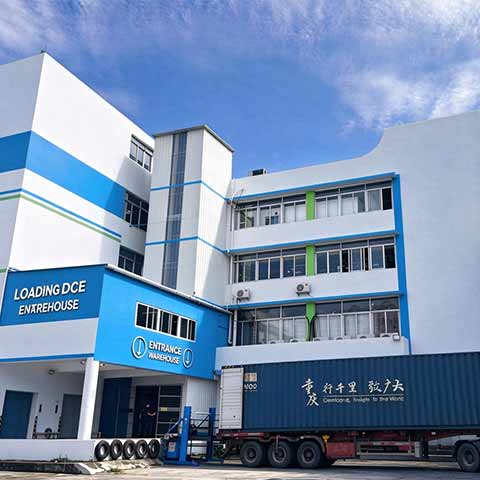
Cabinet fabrication, foam insulation, refrigeration assembly, electronics and software are handled in-house in Shiqiao, Panyu District, Guangzhou. When you ask why a compressor cycles at 8°C, you are talking to the person who assembled it.

Certification you can hand to customs

Every machine is CE, FCC, RoHS and SGS certified, built under an ISO 9001 quality system. Certificate copies ship with the order, so clearance and landlord approvals do not stall on paperwork.

Support that outlives the warranty

12-month machine warranty, spare parts dispatched within 72 hours, lifetime parts supply and remote IoT diagnosis. OEM builds — cabinet colour, signage, screen UI language, voltage — run 35–45 days from approved artwork.

  • CE
  • FCC
  • RoHS
  • SGS
  • ISO 9001
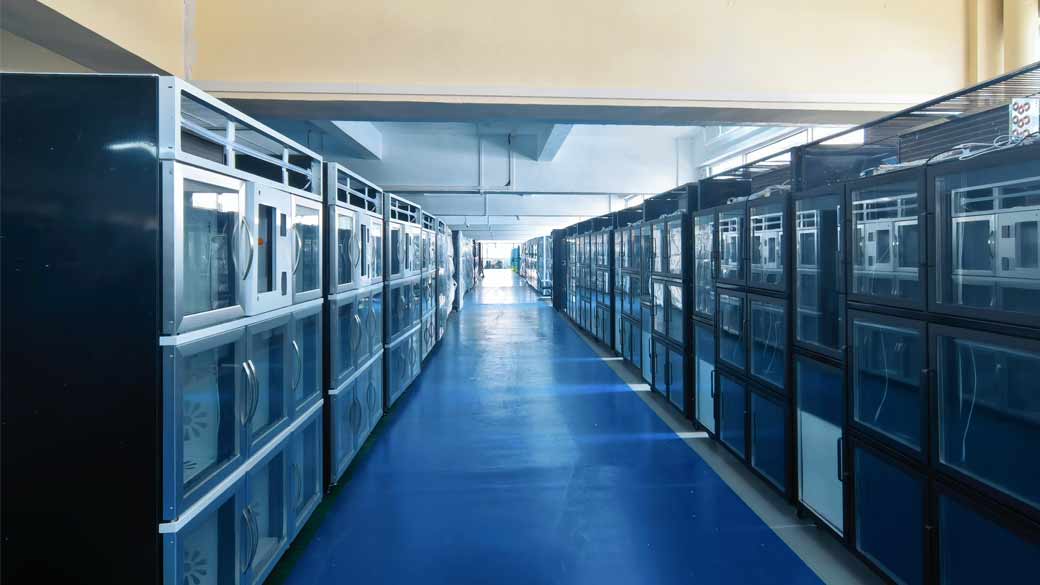
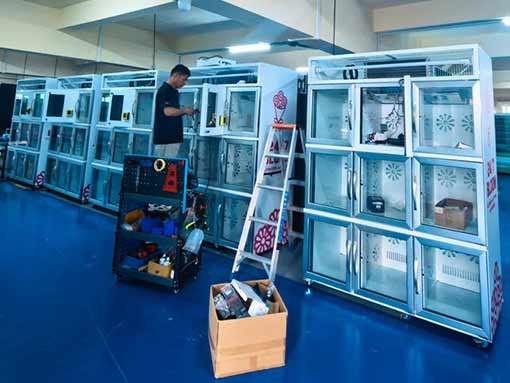
Factory production line assembling refrigerated flower vending machine cabinets
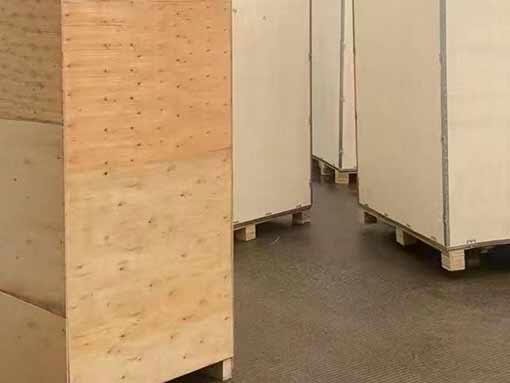
QC engineer running a 72-hour live bouquet cooling test Export packing: machine braced inside a reinforced plywood case
24Hflower factory building in Guangzhou with export loading dock and container trucks
About This Guide

Who wrote it, and how

24Hflower Engineering & Export Team — refrigeration technicians, QC engineers and export managers working on the same factory floor in Guangzhou since 2016. Between us we have commissioned machines in airports, hospitals, malls and metro stations across more than 130 countries.

  • Cost figures come from our own published factory-direct price list, checked on 23 November 2026.
  • Freshness and maintenance advice comes from 72-hour live bouquet tests and operator feedback, not from marketing copy.
  • Sample revenue figures are labelled as samples. We do not publish guaranteed income claims, invented review scores or fake urgency.
  • Nothing on this page is a paid placement. Corrections are welcome at sales@24hflower.com and are logged below.
Version 1.0 — published 23 November 2026. Prices, model table and FAQ verified against the current factory sheet.
Section 15

Flower vending machine FAQ

The fifteen questions we answer most often on calls and at trade shows — short, direct answers you can act on.

How much does a flower vending machine cost?

Factory-direct prices for our four standard refrigerated models are US$3,500 for the 8-slot Grid and Bloom Box series, US$3,600 for the Garden 8 and US$4,600 for the 11-slot Arc. If you need another capacity — 5, 10, 13 or 24 slots — we build it to order and quote it separately. Budget roughly 15–25% on top for sea freight, import duty, unloading and your first stock, so a realistic all-in figure for a first 8-slot site is about US$4,500–5,500.

Is a flower vending machine business profitable?

On a sample of 10–30 bouquets a day at a $10–17 gross margin per bouquet, a single machine can produce $3,000–13,500 in monthly gross profit before rent, power and payment fees. Real results depend almost entirely on location and restocking discipline. Ask for a site evaluation and model your own foot traffic before you buy — anyone quoting a guaranteed monthly income is selling hope, not a machine.

How many bouquets does a flower vending machine hold?

Our four standard models hold 8 or 11 bouquet slots, which covers most first sites. Each slot holds one wrapped bouquet or a group of single stems, depending on compartment height. Need a different capacity? We build 5, 10, 13 and 24-slot cabinets to order — tell us the slot count and bouquet size and we will quote it. For a first site, 8–11 slots is usually the right balance between display choice and sell-through speed.

What temperature should a flower vending machine be kept at?

Between 2°C and 25°C, with the cabinet holding a steady set point rather than swinging. That is the same band professional florists use for cold storage. Stable temperature matters more than the exact number: a machine that cycles between 5°C and 18°C damages flowers faster than a constant 12°C.

How long do flowers last in a vending machine?

Most cut bouquets stay saleable for 3–7 days inside a cooled cabinet, depending on species, how they were conditioned before loading and how often the compartments are opened. Roses, carnations and chrysanthemums are the most forgiving; hydrangeas and lilies in tight bud need more care. Load pre-hydrated bouquets with water tubes and rotate stock first-in, first-out.

Where is the best place to put a flower vending machine?

The best sites combine dwell time with a gifting trigger: hospitals, malls, metro stations, airports, hotels, campuses and 24-hour convenience stores. Rank a candidate site on foot traffic, visibility from the main walkway, available power and whether people are already spending money there. A busy corridor with no gift moment underperforms a quieter lobby next to a hospital exit.

Do I need a licence or permit to operate a flower vending machine?

In most markets you need a general business licence and the landlord's written approval, and some cities treat vending as a separate permit category. Fresh flowers are usually regulated far more lightly than food, but rules vary by country and state — confirm with your local business authority before signing a lease. We supply CE, FCC, RoHS and SGS certificates plus the user manual to support your application.

Can a flower vending machine accept card and mobile payments?

Yes. Machines are configured with cash, bank card and QR / mobile wallet modules before shipping, matched to your market — cards and contactless in the US, UK and EU, QR wallets in Asia, and local providers on request. Payment settlement goes to your account, and you should confirm transaction fees with the provider before choosing a configuration.

How often do you restock a flower vending machine?

Plan on one or two visits a week, 30–60 minutes each, plus extra visits in peak gifting weeks such as Valentine's Day and Mother's Day. The remote dashboard shows per-slot stock and sales so you bring the right mix instead of guessing. Restocking frequency, not machine quality, is what usually limits how many machines one person can run.

What space and power supply does a flower vending machine need?

A floor area of roughly 1–2 m² plus 10 cm clearance at the rear for airflow, on a level surface. Power draw is 950 W on our standard models (a 24-slot custom build draws about 1,900 W), with 110V or 220–240V AC 50/60Hz configurable per market. A standard dedicated circuit is enough; no plumbing or drainage is required.

Should I buy an 8-slot or an 11-slot machine first?

Start with an 8-slot model unless you already know your site sells 15+ bouquets a day, in which case the 11-slot Arc gives more display choice. A larger custom cabinet (13 or 24 slots) needs enough daily sales to turn stock before it ages, and it costs more to fill. Prove the location first, then add capacity or a second machine once you know your real sell-through rate.

How long does shipping and installation take?

Standard models take 20–30 days from deposit to a finished, tested machine; OEM and custom branding take 35–45 days. Sea freight adds 15–40 days depending on the destination port, air freight 5–10 days. Flower vending machine installation is a delivery and levelling job — the machine arrives pre-configured and we commission it remotely with your team by video call.

What warranty and spare parts support should I expect?

Every 24Hflower machine carries a 12-month warranty covering defective components under normal use, including the cooling system, screen, payment module and control board. Spare parts are dispatched within 72 hours, parts supply is lifetime, and a starter parts kit ships with the machine. Ask any supplier for a written parts price list before you order.

Is buying from a manufacturer cheaper than buying from a reseller?

Usually yes, but the bigger difference is accountability. A factory quotes its own build cost, answers technical questions with engineers, supplies matching spare parts and can customise the cabinet; a reseller adds margin and forwards problems. Ask for a live video tour of the production line — a trading company will rarely agree to one.

How do I start a flower vending machine business step by step?

Pick and score a location, confirm power and landlord approval, choose an 8–11 slot refrigerated model, arrange payment modules for your market, order and clear customs, install and load the first 60–100 bouquets, then restock one to two times a week using dashboard data. The full sequence, with typical timings, is laid out in the 30-day launch plan above.
Still deciding? — you will get a model recommendation and landed cost within 24 hours.

Next Step

Ready to price your first machine?

Tell us your city, venue and the bouquet size you plan to sell. We will recommend one model, quote it with freight to your port, and tell you honestly if a smaller machine would earn more.

See how ordering works

Or email sales@24hflower.com — reply within 24 hours, Monday to Saturday.

We are using cookies to give you the best experience on our website. You can find out more about which cookies we are using or switch them off in settings.